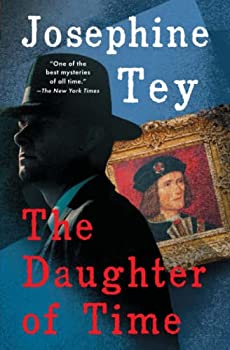
Until very recently, I had not heard of Josephine Tey (1896-1952). She was an extremely popular English mystery writer whose early death from cancer prevented her from creating the kind of canon writers like Margery Allingham and Agatha Christie did.
This book features her detective inspector Allan Grant, who is laid up in hospital with a severely fractured leg as a result of a fall while in pursuit of a criminal. He’s a very rational man, who prefers fact to fiction and is finding forced confinement, with the kinds of books people are sending him, to be difficult indeed. But, factual though he is, he has the quirk of being drawn to faces. Early in his career he discovered that he could use what he saw in one to help him determine who was lying, who was guilty. But in a hospital bed, in the years before television everywhere and decades before the internet, the only faces he sees on a regular basis are the cute but bullying tiny nurse he calls The Midget and the tall and comforting nurse he calls The Amazon.
Then actress friend Marta brings him a sheaf of prints of portraits and he suddenly finds himself obsessed with the portrait of a man who – at first glance – everyone he shows it to takes for a judge or some other upright person. But when they learn who he is, their judgement always turns harsh and he’s perceived as a monster: Richard III, last of the Plantagenet kings of England.
Grant, with the help of his actress friend’s “woolly lamb” Brent Carradine, an American doing research in London to be near his actress girlfriend, begins trying to untangle the mystery surrounding Richard III – and to determine if he really was responsible for the deaths of his two young nephews, the “princes in the Tower.”
Several mystery writers have assayed the detective-solves-old mystery-while-in-hospital plot, but seldom as well as Tey. Her writing is straightforward but filtered through the droll mind of Inspector Grant, it is charming. In Robert Barnard’s introduction to the recent edition by Scribner’s he says she always had “control of her reader’s sympathies,” and I can attest to that.
By the time he’s ready to go home, Grant has solved the mystery to his satisfaction and discovered that though Richard III is still in the history books as a villain, historical scholars had already amassed more than enough factual evidence to show he was not the hunchback with a withered arm desperate for power that he had been portrayed as for nearly 5 centuries after his death. It was his public reputation that needed rehabilitation.
After I finished this novel, I looked up the news articles on the finding of Richard III’s remains in the Leicester parking lot and his subsequent reburial at the cathedral. Even at this point, the observers were reluctant to bring up his still controversial reign, instead focusing on the surprise of finding such a monumental English historical personage in the way Richard had been found and on the acknowledgement of his status as an anointed king of England.
This brought me back to Tey’s novel where at one point Grant and his friend Marta have a conversation about why it is that people confronted by facts tend to dig in their heels and get angry when those facts contradict their long-held beliefs. And this too was one of Tey’s strong points as a writer: she could weave an observation about our cultural foibles into her story that transcended the story itself, but without being either offensive or obtrusive.
I will certainly read more of her work.

 Robyn McIntyre - a writing life