Deeper Understanding of Our Facts
Knowing something and knowing something can be two different things. Most of the time, we know a thing intellectually, like global warming is changing the face of our planet, or that our partner loves us. We accept those things as facts, but it isn’t until we have a sort of emotional awakening to go with that knowledge, that we fully comprehend it.
We see a picture of how a glacier is now 50 percent of what it was a decade ago, or we have a narrow escape and see our partner completely distraught because of it, and we suddenly have a more complete picture of the fact we merely accepted before.
I had one of those recently: I’m approaching elderly.
It’s not as though I wasn’t aware; of course I was. I can count the candles on my cake. I make jokes to the supermarket checkers about being able to remember when an avocado cost a lot less than a buck.
Lately, I’ve been annoyed by a spate of articles blaming everything that’s wrong with modern life on Baby Boomers (and no – realizing we did the exact same thing to our own parents and grandparents and they to theirs doesn’t make it any more palatable). I knew intellectually that I’m considered old by a good sized segment of the population. It’s irritating to have people discount you because you’ve lived longer than them, but it happens. Still, both the number of cake candles and casual ageism were just facts that I accepted as evidence that I’m older. Not the same as knowing it.
Lots of people mark their aging firsts – first grey hair, first noticeable web of wrinkles, first chronic ache or pain. But age can still sneak up on you; you might not really notice even when your social chatter has gone from who’s doing whom, then right past investments and baby sitters, to what the doctor said the last time you had an office visit. Because you never actually feel old. No one does until they can’t help it any more.
And eventually you can’t help it because some thing, a fact, conjoins with experience, causes an emotion, and all of a sudden you realize.
I’ve got some medical issues – most of them related to genetic predisposition (thanks, family), but nothing that can’t be regulated by some medication and a little more attention to self-care. Except for the tendinitis from decades of keyboarding lots and lots of words, I haven’t noticed much difference in my physical life. Then last month, my doctor took me off one medication and moved me to another because she was worried that the previous meds were interfering with my kidney function. Just an adjustment. A minor adjustment. And yet…
All of a sudden, I saw myself at the beginning of the end of the road. I didn’t have a panic attack about it, but I admit to being unsettled. This type of thing is the point where you start looking for mitigation – people in my family tend to live long lives without much frailty and I clutched that observation to me as though it was a life ring. But even as I tried to minimize the effects aging has had on me so far, I truly understood for the first time that, from now on, my life may become more and more circumscribed by a process over which I have limited control.
Someone once said that from the moment we are born, we move towards death. I could have as many as four decades left or as little as one day or even one hour. No one knows when their existence will end, and I’m fine with that.
What gets me is how I went from knowing this thing to knowing this thing.
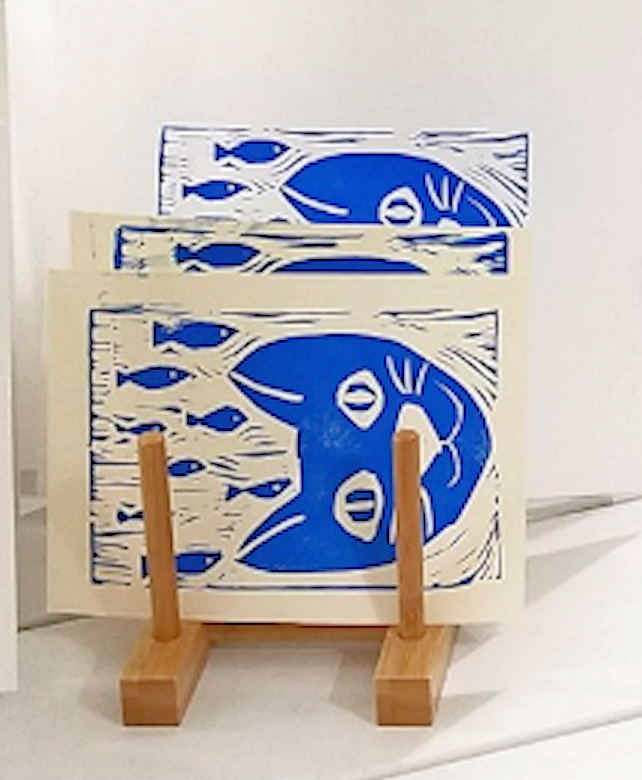
I attended a block printing workshop a month or so ago and had prepared by drawing what I wanted to print, only to discover my drawing was slightly too large for the block provided. It would have taken a while and materials I didn’t have to reduce the size, so I opted to improvise by drawing something new: A wide-eyed cat with little fish raining down around her.
When I started writing this post, that block print came to mind. We all indulge in fishful thinking – it’s our capacity to imagine, to daydream and turn those dreams into something concrete and touchable that makes for some of our most worthwhile creations. But we’re also the kind of creatures to let facts lay shallow in our minds – to understand them on a thin level, not touching us in any other way until something happens that changes that, which is usually an experience.
So we might say we understand that saying “one day at a time”, but it takes on a deeper, richer meaning when you have to struggle hard to maintain your equilibrium because of addiction or illness, whether yours or someone else’s.
Accepting the facts of your life is something many religions and philosophies strive to teach, but they also teach that we should work for a deeper understanding of ourselves and our world. Deeper understanding can be hard to achieve, despite putting in a lot of work. So it almost seems a wonder – those moments when a fact comes together with experience and emotion to create that deeper understanding. Like an unexpected and unusual rain.
Because we only have the one (physical) life on this planet, living it is the most important thing. But living it with the most understanding of what it truly is – connecting what we know to what we have experienced and what it makes us feel can challenge us and result in a richer understanding and appreciation of our lives, no matter how long they may be.

 Robyn McIntyre - a writing life
